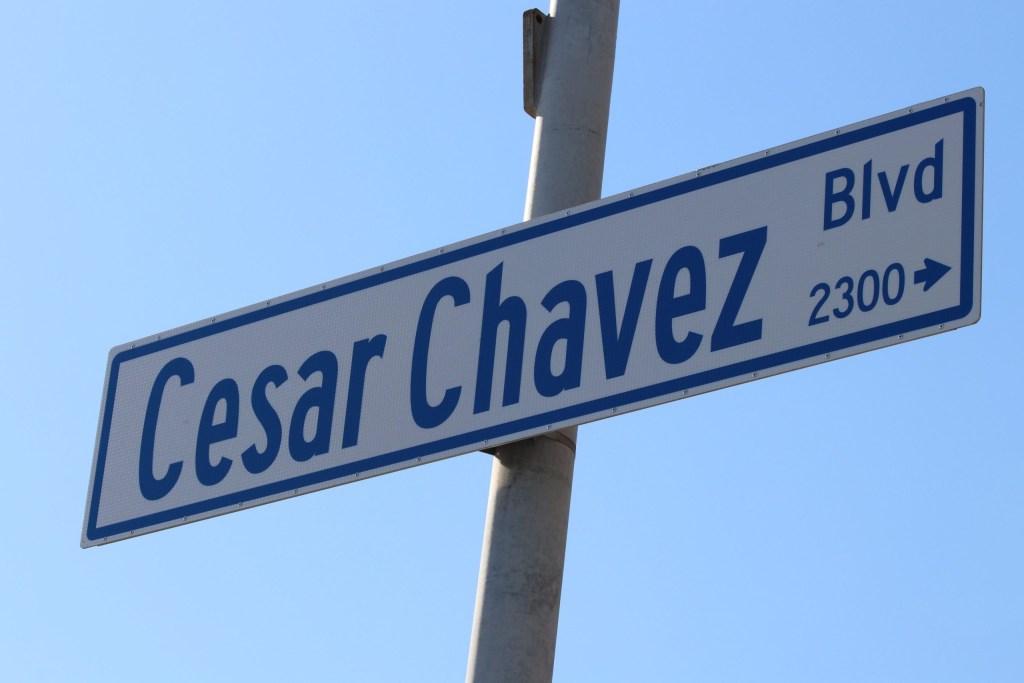

The Fresno City Council held a special meeting on Thursday to initiate the process of changing local streets named after Cesar Chavez following news earlier this week that the iconic farmworker advocate raped and sexually assaulted women and children.
The city announced the special meeting following the publication of a New York Times investigation published Wednesday that saw first-hand survivors detail their encounters with Chavez.
Chavez was best known as being one of the leading figureheads in the farmworkers’ rights movement, leading to significant gains that can still be seen today, like the formation of the United Farm Workers union. Many of those accomplishments were recognized with tributes to his legacy in the form of statues, and streets being named after Chavez.
Most of those tributes have begun the process of being reconsidered, if not outright rescinded, in the wake of the Times’ investigation.
“It’s important we do not let this overshadow the wins that came from that union,” said west central Fresno City Councilmember Annalisa Perea at Thursday’s meeting.
Southwest Fresno City Councilmember Miguel Arias, whose father was a farmer and who worked at a farm himself, said he was “shaken” upon learning of the allegations against Chavez.
Among the victims of Chavez’s sexual abuse was Dolores Huerta, another leading icon in the farmworker movement. Arias said that when somebody like her, a “matriarch” in the Latino community, speaks up on an issue, it’s important for him to listen, and to put the focus on survivors instead.
“It’s important for us to acknowledge their pain, their suffering, and believe the survivors and ensure they’re not erased as part of this conversation,” Arias said.
The council unanimously approved to initiate the renaming process on Thursday.
Their vote will not immediately rename Cesar Chavez Boulevard. There will be at least two more meetings in the future, confirmed Fresno City Attorney Andrew Janz, providing residents with an opportunity for public input.
In 2023, the City of Fresno approved changing the names of portions of East Kings Canyon Road, East Ventura Avenue, and West California Avenue to Cesar Chavez Boulevard.
The name change was approved despite some pushback from residents who felt that part of the city’s culture and history were being erased, and by business owners operating by the streets who said the move would introduce a financial burden on them.
The Fresno County Board Of Supervisors rejected a similar proposal in 2023.
Recounting those comments from constituents, northwest Fresno City Councilmember Mike Karbassi proposed having the streets reverted back to their original names.
Fresno Mayor Jerry Dyer said at Thursday’s meeting that he would sign the legislation needed to rename the streets as soon as it reached his desk. He added that, though some new signs will have to be ordered for full installation, some old ones remain in city storage. He said he expects work to begin on street renovations in April.
Fresno City Council President Nelson Esparza said that decision would make the most economical and practical sense for the city.
Both the proposal to remove Chavez’s name and revert the streets back to their original titles was not met with unanimous approval by the public at Thursday’s meeting.
“I’m not defending Cesar Chavez but I think, maybe because I’m a teacher, I look at this as a teaching moment. That we do need the sign up there, ” said Olga Valle who identified herself as a former farm worker and Fresno Unified School District worker. She was not the only resident who spoke up to share complicated feelings with having Chavez’s name removed.
Some business owners also spoke up on Thursday to let the councilmembers know that they were about to be subjected to the same financial burdens the council put them through three years ago when the street names were first changed.
Much of what is currently Cesar Chavez Avenue is located at a major corridor that runs along southeast Fresno, in Councilmember Brandon Vang’s District. Vang was not in office when the change was made in 2023, but said he was aware of the frustration from business owners, and would try to keep them in mind going forward.
“I am going to talk to constituents and business owners to see what we can do as a city to make (the name change) as less painful as possible,” Vang said. “So that this does not hit their bank account like it did.”
Once the allegations against Chavez became clear, Fresno joined leaders across the country in taking steps to remove local symbols of Chavez’s legacy.
The Fresno County Board of Supervisors announced their own special meeting on Wednesday to rename Cesar Chavez Day to “Fresno County Agriculture Appreciation Day.” That meeting is scheduled for Monday, March 23 at 11:30 a.m. at the Fresno County Hall Of Records.
Fresno State announced on Wednesday that they would be taking down their on-campus Chavez statue.
State lawmakers announced plans to rename the March 31 Cesar Chavez holiday to “Farmworkers Day” on Thursday morning.
Chavez’s allegations also come at a tough time for farmworkers.
The same day the Times’ published their investigation, farmworkers across the county, including in Fresno, protested against policies by President Donald Trump’s administration that could see the laborers lose billions in annual wages.
Fresno City Council elects new leadership following abrupt president resignation
The Fresno City Council started their Thursday meeting by electing new leadership, following an abrupt resignation announcement from their council president late last week.
Esparza and Tyler Maxwell were unanimously elected as the council’s new president and vice president, respectively.
This year will be Esparza’s second time as council president. He last served in the role in 2022.
The president’s responsibilities include managing the meetings, and taking a role in deciding what gets placed on the agenda.
The leadership shakeup comes following an announcement last week from Fresno City Councilmember Mike Karbassi that he was stepping down from his role as president. He cited a desire to focus on his campaign for Fresno County Supervisor, and endorsed Esparza succeeding him in his role.
Karbassi is only stepping down from his role as council president. He is not resigning from Fresno City Council.
Karbassi was given a golden wrestling-championship-like belt as a going away gift. Esparza was given a golden gavel by Karbassi to welcome him into his new role.
Fresno initiates study on local corporate homeownership
The council unanimously approved a study to identify the effects of corporate homeownership in the city.
Plans for the study were brought forward by Perea. She said at Thursday’s meeting that the idea came when she discovered that the city does not monitor homeownership from corporations or institutional investors.
She said she hopes the study will give the city “a better idea of how much of a problem this is within the City of Fresno.”
No specific consequences were announced at Thursday’s meeting, though the study may be the first step toward introducing such legislation.
“Once we get that study,” Perea said, “the goal is to do some research and to determine if there are any ordinance amendments or any need to introduce new ordinances to better hold these corporations accountable.”
Fresno County has the highest share of single family homes owned by corporations in the San Joaquin Valley, according to city documents.
The City of Fresno’s Rental Housing Improvement Program includes a registry of properties within the city, but it does not monitor corporate home ownership trends.
City documents say results of the study would be available within 75 days.
Studies on corporate homeownership have drawn a vast array of conclusions across the country. Though some effects have been positive, the growing housing crisis nationwide has introduced pressure for local governments to be more strict to corporate investors who let their properties succumb to substandard conditions.
Trump announced a desire to introduce legislation to add restrictions to corporate homeownership earlier this year, as did California Gov. Gavin Newsom.
Council pumps the breaks on facial recognition technology at City Hall – for now
The Fresno City Council punted a proposal to look into installing facial recognition technology at City Hall.
The proposal was brought forward by North Fresno City Councilmember Nick Richardson.
The proposal brought forward on Thursday asked staff to conduct a study looking into how feasible implementing that technology would be. But that language wasn’t clear to some residents, as it came following an eleventh hour amendment to the original proposal by Richardson.
Richardson’s proposal would have facial recognition technology flag people entering City Hall who are convicted sex offenders. He was motivated to introduce the legislation following concerns that the city may not be doing enough to protect vulnerable groups, specifically minors and children.
However, concerns were raised by some councilmembers and residents that the technology could infringe on people’s rights to privacy, or be biased or discriminatory against individuals — both of which could open the city to litigation.
The council eventually moved to retract the proposal and directed Fresno City Attorney Andrew Janz to conduct the study. The council said they’d return to discuss the matter as a closed session item in future council meetings.
Esparza and other councilmembers were not totally against the idea, but he said he also wanted to make sure that the facial recognition technology was the best way to handle child safety concerns at City Hall.
“We’re not trying to use a bazooka to take out ants,” Esparza said on Thursday.
Child predators, in particular, have been a talking point among local elected leaders following the brief, failed bid by Rene Campos, a local sexual offender, to run for Fresno City Council.
The council voted on Thursday to unanimously support state legislation brought forward by Assemblymember Esmeralda Soria (D-Merced) to ban sexual offenders from running for public office.
Karbassi said he “commends” Soria for introducing the legislation, especially since it came without the city asking her to do it. He was among a group of councilmembers on Thursday who said they received calls from constituents asking how they could let a sexual offender run for public office.
“What made me really upset as a local policymaker is, I couldn’t do anything about it,” Karbassi said. “And that’s frustrating.”
Fresno Police Department to hold public hearing on military equipment use
The Fresno City Council also punted on approving the renewal of a state-mandated report for local police departments’ use of military equipment.
California Assembly Bill 481 requires local law enforcement to obtain permission from their respective government body to use and purchase military equipment. The legislation requires an annual review.
Fresno Police Chief Mindy Casto presented the review on Thursday.
She said the police department’s most frequently used piece of military equipment last year was their drones, used 293 times. She said the drones were used during operations like a search and rescue or to observe an active crime scene.
She added that the police department does not expect any “major acquisitions” of military equipment for the next fiscal year.
The Fresno City Council was initially scheduled to approve the review on Thursday, though it was announced at the top of the meeting that a vote was moved to March 26.
Some of the councilmembers said they received input from constituents that they felt the city may not be doing enough to provide the public with opportunities for engagement on the item leading to Thursday’s meeting.
Casto said at Thursday’s meeting that the police department engaged in multiple community engagement meetings, but that this year’s community engagement requirement would be “enhanced” through an additional meeting.
That meeting by the Fresno Police Department will be Wednesday evening at City Hall.
The post Changing Cesar Chavez Boulevard in Fresno — again appeared first on Fresnoland.