California Governor Hopefuls Clash Over Agriculture, Affordability and Water Policy
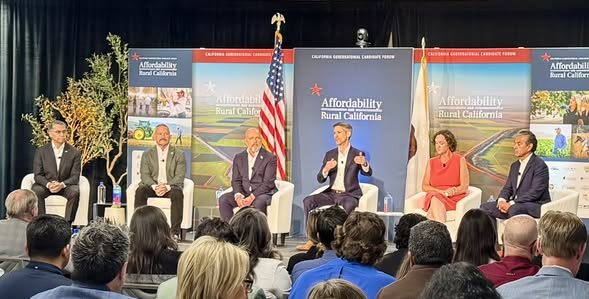
Six gubernatorial hopefuls took center stage at Fresno State’s Resnick Student Union on Wednesday, each charged with answering the question of how rural Californians can keep a roof over their heads and gas in their cars in the nation’s most expensive state.
“There’s no better place for this conversation than the Valley,” said Blake Zante, who provided opening remarks. “We’re one of the most productive regions in the world, but we’re one of the most overlooked in Sacramento.”
The Maddy Institute, along with Western Growers, the Agricultural Council of California, and the California Farm Bureau, hosted the forum. Former California state legislator Kristin Olsen-Cate and Fresno County District 4 Supervisor Buddy Mendes moderated.
The candidates—Xavier Becerra, Chad Bianco, Steve Hilton, Matt Mahan, Katie Porter, and Antonio Villaraigosa—all had two minutes to deliver an opening and closing statements. Tom Steyer and Eric Swalwell were invited, but did not attend.
The candidates clashed over affordability, regulation, water policy and energy costs—issues they agreed are central to the survival of the state’s farming economy.
Former U.S. Health and Human Services Secretary Xavier Becerra framed the moment as urgent, calling California’s challenges “an affordability crisis that we must tackle straight on.”
Drawing on his experience managing large public budgets, Becerra said the state needs disciplined leadership and pledged to declare a state of emergency to address rising costs, while also focusing on healthcare and energy. Riverside County Sheriff Chad Bianco echoed the concern, promising fiscal restraint and a balanced budget, arguing that “government shouldn’t spend more money than it has.”
Within his first 10 days in office, Bianco promised, he would remove all regulatory restrictions.
“I am giving you your farms back,” Bianco said. “Regulations are easy to remove because they were not put in place by lawmakers. They can be removed with strokes of pens.”
Candidates repeatedly returned to the pressures facing agriculture, which many described as overlooked in Sacramento. San Jose Mayor Matt Mahan said farming communities have too often been treated as “second-tier,” pledging to elevate their concerns and pursue sweeping reforms to the California Environmental Quality Act. Businessman Steve Hilton, speaking as an outsider, sharply criticized Democratic leadership and called for rolling back costs tied to regulation, vehicle fees and fuel, while advocating for a dramatic reduction in gas prices. Hilton promised $71 annual vehicle registration fees and $3 per gallon gas.
Former Congresswoman Katie Porter focused on affordability from a household perspective, linking agricultural sustainability to broader economic pressures. She proposed eliminating state income taxes for Californians earning less than $100,000 and emphasized housing costs as the largest burden on families. Former Los Angeles Mayor Antonio Villaraigosa argued that the next governor must “get things done” and called for a more collaborative approach to regulation, including working with farmers rather than imposing top-down mandates.
Energy policy emerged as a key driver of food prices, with candidates largely agreeing that high energy costs ripple through the agricultural supply chain. Bianco called for energy independence, including expanded oil production and nuclear power, while Mahan and Porter pointed to regulatory burdens as contributors to rising food prices. Villaraigosa emphasized modernizing refineries rather than further restricting them, and Becerra stressed the need to “get our energy right” as part of a broader affordability strategy.
Water policy prompted some of the sharpest divisions. Most candidates endorsed an “all-of-the-above” approach to water storage and conveyance, though their proposals varied widely. Bianco called for building “massive dams” and additional reservoirs, while Hilton advocated for dredging the Sacramento-San Joaquin Delta and raising Shasta Dam. Villaraigosa agreed on a comprehensive strategy, while Porter cautioned that “there is no magic wand to create more water.” Candidates also debated the implementation of the Sustainable Groundwater Management Act, with several criticizing it as overly complex but stopping short of calling for its repeal.
Regulation more broadly became a flashpoint, with Bianco pledging to remove many rules quickly, arguing they can be undone administratively. Others, including Porter and Mahan, acknowledged the burden of regulation but called for targeted reforms rather than sweeping eliminations.
Despite moments of levity, the debate underscored a shared recognition that the future of California agriculture is deeply tied to the state’s broader affordability crisis. In closing remarks, candidates sought to connect their personal stories and governing philosophies to the Central Valley. Becerra highlighted his family’s roots as farmworkers along Highway 99, while others emphasized accountability, reform and economic sustainability.
The candidates largely agreed on one point: the fate of rural California—and the agricultural industry that underpins it—will be a defining issue for the state’s next governor.
For more updates on Fresno County development and business initiatives, stay connected with the Fresno Chamber of Commerce.