
Theiten Guizar, 20, grew up thinking politics and voting were for people with more privilege than he had. That perspective shifted after President Donald Trump’s reelection in 2024, when Guizar began seeing how far-reaching policy decisions could terrify and displace Latino communities.
“There was a mentality of, ‘We don’t even make enough to be affected by these policies,’” Guizar said. “When, in reality, that’s not the case at all.”
When Guizar is not attending nursing classes at Fresno City College, he channels that epiphany into action. He’s canvassing across Fresno and Tulare counties with PowerCA Action, talking to young voters and Latino residents, and spreading information about civic engagement and voting.
Through his canvassing work, he has observed that many Latinos tend to keep to themselves and feel disconnected from both local and federal government. Many feel unrepresented, and with the added threat of new voting barriers and a stronger presence of enforcement agencies, “it really just causes a disparity within those communities.”
“I felt the need to inform my community because we are unrepresented,” Guizar said. “We have the ability to voice our opinions and make a change that we want to see and be able to vote, organize and facilitate these conversations within our community.”
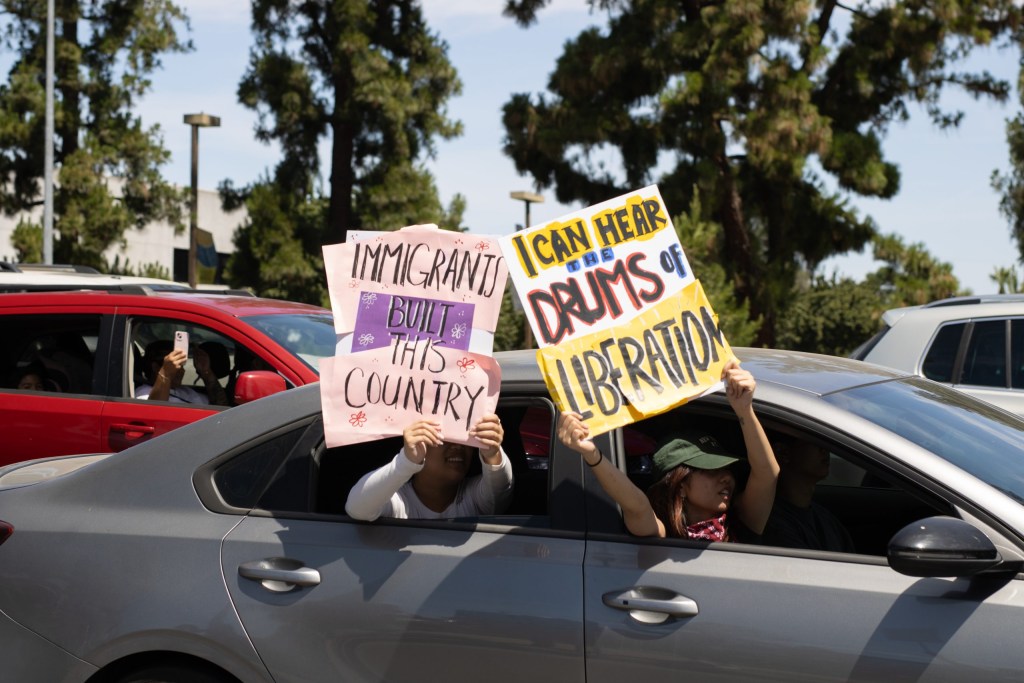
Organizations across Fresno County are ramping up efforts to register young Latino voters ahead of the upcoming midterm election, even as fears around immigration enforcement grow and voter confidence remains low. Many are working to rebuild trust and empower residents to participate in public life and vote safely.
Concerns about voting
In the central San Joaquin Valley, 66% of Latino voters surveyed late last year were worried about Trump sending agents to polling locations. Christian Arana, vice president of civic power and policy at the Latino Community Foundation, emphasized that they polled Latino voters, who, by definition, are American citizens.
Across the country, rampant, aggressive tactics by immigration enforcement have only intensified after the U.S. Supreme Court OK’d racial profiling in immigration stops and ICE agents were deployed to various U.S. airports amid a historic funding showdown.
“They sold everybody the idea that they were just going after criminals and gang members and rapists,” Arana said. “That’s their language. But ultimately, what all of us are seeing in real time was that they were literally going after the farmworker. They were literally going after the mom that was just trying to go to work.”
That fear has limited participation in everyday life across Central Valley communities. Marisa Moraza, political director for PowerCA Action says she’s seen a lot of hopelessness particularly among young voters under 30 who feel that “nothing can change” and that their vote is essentially useless.
Combined with ongoing challenges tied to Trump and his administration — who have repeatedly claimed, without evidence, that widespread voter fraud exists — persuading voters to stay engaged is difficult at best. The claims have been used to justify legislation that would overhaul voter registration processes and have triggered nationwide uncertainty around voting policies.
A 2025 Brookings Institution analysis found fraud to be extremely rare — about 0.000043%, or roughly four cases per 10 million mail-in votes. The analysis noted that universal mail-in systems are less susceptible to fraud than absentee ballot systems.
“We think it’s really important that we’re building up the power of young folks to be active participants in their community,” Moraza said. “But also, we know young folks are usually a go-to resource for their communities, for their parents, or the multi-generational households that they’re living in.”
Organizers say voter engagement in general must be multifaceted. Ivette Villarreal, civic engagement program director at Valley Voices, said that people are less likely to engage in voting if they’re struggling to meet basic needs or are unable to understand what’s on the ballot if it isn’t in their primary language.
“As somebody who, myself, is an immigrant, and who hasn’t always had the right to vote, I know how overwhelming it can be to wrap your head around all the information during an election cycle,” Villarreal said. “And sometimes you can read things that are on the ballot 10 times, and it does not make sense, especially propositions.”
Immigration enforcement at polling places is illegal and unlikely, according to officials
Last year in Kern County, Dylan Bryant watched immigration enforcement operations spark fear that spread like wildfire.
While leading a disaster preparedness campaign at Bakersfield City School District parent resource centers, Bryant noticed a sharp drop in parent engagement. Coordinators told him that rooms that were once full were now sparsely attended.
“We’ve heard anecdotally that folks are generally concerned to engage in civic life and public life,” Bryant said. “Especially folks that are either directly impacted by their immigration status or folks that are in the process of becoming citizens or currently in the immigration process.”
That fear has limited participation in everyday life across Central Valley communities. Dylan Bryant, the integrated voter engagement coordinator at Faith in the Valley, said his group is working to rebuild trust and empower residents to participate in public life and vote safely.
Fast forward to the state’s Prop 50 election, Fresno was announced as one of just five California counties that the federal government planned to monitor and Latino voter groups said the move sparked even more fear in the community.
But many voter groups and even California law enforcement officials have said armed federal agents at local polling stations are as illegal as they are unlikely.
In an email statement to Fresnoland, press staff from the California Secretary of State confirmed that, under California law, strict prohibitions limit law enforcement activity near or at voting locations.
“We will combat any force that seeks to disenfranchise those wishing to exercise their right to vote and will continue to educate and empower all eligible voters to cast a ballot,” a California Justice Department representative said in the statement.
The White House and a top DHS official have also said there are no plans to deploy ICE agents to polling sites this year. However, those assurances have done little to alleviate fears amid on-going raids and captures.
James Kus, the Fresno County Clerk/Registrar of Voters, said he also does not anticipate immigration enforcement at polling places unless they are actively voting themselves.
Still, many worry that those fears and frustration might incentivize thousands of young and Latino voters to just sit out the upcoming June 5 primary.
“Unfortunately, I don’t think voting issues are a priority in the community yet, because of the constant unfortunate siege on them,” said Lourdes Medina, an advocacy and communications associate with Services, Immigrant Rights and Education Network (SIREN).
The stakes are especially high in majority-Latino communities like Fresno County. According to Political Data Intelligence, about 52% of registered Latino voters cast a ballot in the November 2024 election.
In 2024, Latino voters were both credited and blamed for helping return Trump to the White House. While about 56% still backed the Democratic candidate, Trump won a record share for a Republican, with exit polls showing a 14-point swing toward him.
With midterm elections approaching and voter confidence falling, some analysts now argue that shift was overstated — and that Trump could face a reversal similar to George W. Bush, who saw the historic Latino support he drew in 2004 fade by 2006 after anti-immigration policies sparked backlash.
How proposed legislation will impact immigrants, people of color, trans people
Even as officials downplay threats of armed agents at polling sites, the more immediate and potentially dangerous threat to voting rights, advocates say, are the White House’s historic efforts to federalize elections.
Three bills introduced this year outline significant changes to voter registration and election administration, among other changes. If passed, it would shape the rules for future federal elections and how states would be required to run them.
The Safeguard American Voter Eligibility (SAVE) Act, focuses on requiring voters to provide proof of citizenship to register, even though more than 21 million Americans lack readily accessible documents confirming citizenship, such as a passport or birth certificate.
It would also eliminate the ability to register to vote online or by mail by requiring that voters submit documentary proof of citizenship in person.
In Fresno County, Kus said about 90% of voters typically cast ballots by mail, though the share varies by election. Presidential general elections draw higher in-person turnout, while primaries — particularly gubernatorial primaries — see more mail-in voting and lower overall participation.
The change would also create new barriers for voters, such as people with disabilities, who rely on the convenience of remote or mail registration options.
In Kansas, where documentary proof of citizenship is already required, the law blocked over 30,000 potential registrants, around 12% of all voter registrations, in just two years despite 99% of the potential registrants being U.S. citizens, according to findings by the Institute for Responsive Government.
Critics say the bill would also push states to rely on the Department of Homeland Security’s SAVE database for voter eligibility checks, even though it was built for public benefits verification. It would also aggregate highly sensitive personal data in a federal database without clear transparency about security, auditing, or limits on use.
Federal verification databases have historically produced errors in which U.S. citizens are incorrectly flagged as noncitizens, raising the risk of eligible voters being wrongfully removed from voter rolls.
The California Secretary of State also voiced concerns about how the SAVE Act would create barriers for millions of voters, target underrepresented communities, and burden election administration “by imposing unrealistic, costly, and unnecessary requirements on state and local elections officials.”
The SAVE America Act, and the Make Elections Great Again (MEGA) Act, are both bills built on the framework of the SAVE Act.
The differences include requiring voters in every state to present qualifying photo IDs to cast a ballot in federal elections (SAVE America Act). It excludes several commonly-used forms of identification, including student IDs and public assistance IDs such as Medicare and Medicaid.
“It’s making our country less democratic, or it’s an attempt to make our country less democratic, and it’s also something that we’ve already settled in American history,” Bryant said. “If you look back at the right to extend the vote to Black communities, to women, to anybody who now has the right to vote in the United States, we’ve already determined that we can’t enact things that are effectively poll taxes. And that’s what a voter ID law is.”
The MEGA Act would require ballots to be received by election officials on or before Election Day to be counted in federal races, even if they are postmarked by Election Day.
A total of 15 jurisdictions, representing 43% of voters in the 2024 election, currently allow mail ballots to arrive after Election Day as long as they are postmarked by that day. Eliminating this flexibility could create a bifurcated system like Arizona’s, which has faced intense scrutiny over the years.
Immigrant organizers and advocates told Fresnoland that these bills would not just burden immigrants, but young and first-time voters, low-income Americans, women, trans people, people of color and military members.
“We wanted to raise our voice on this, because if this does pass, it would spell a lot of trouble for the political power of so many people, especially Latinos, and in the year where so many issues are at stake, we cannot sit by and let this happen.” Arana said. “We encourage everyone else to speak up because it really is a threat to our democracy.”
The post Amid fear and confusion, this Fresno college student is trying to help turn out Latino voters in June appeared first on Fresnoland.