
With Fresno County’s transportation tax replacement failing a key initial verification process — jeopardizing its advancement to the November ballot — it falls on elections staff to sift through at least 21,000 signatures in time for the election.
And while Andy Levine, campaign manager for the Better Roads Safe Streets Initiative, said he’s fully confident the half-cent sales will go before voters in November, Fresno County Clerk/Registrar of Voters James Kus could not offer that same guarantee.
With seven other propositions to juggle and an election underway, elections staff have a tremendous task before them to verify petition signatures in time.

The county gives the measure until Aug. 7 to be verified, but functionally, if they can’t get certified by July 14, it will take an appeal to the Fresno County Board of Supervisors to get a special meeting scheduled.
The rub is that the the supervisors have been at loggerheads with the Better Roads Safe Streets about everything in the ordinance from the process to the contents to the players.
County Will Consider Special Meeting Request if Needed: Bredefeld
Two duplicate signatures found by staff kept the ballot initiative from passing the random sample verification process.
A penalty for the duplicates combined with the 77% validity rate pushed the petition below the acceptable threshold.
“We didn’t have quite enough to automatically qualify for the random sample, but more than enough to be able to move on to the full count, which we welcome, are excited about, and have absolute even more confidence than that number,” Levine said at a news conference Wednesday.
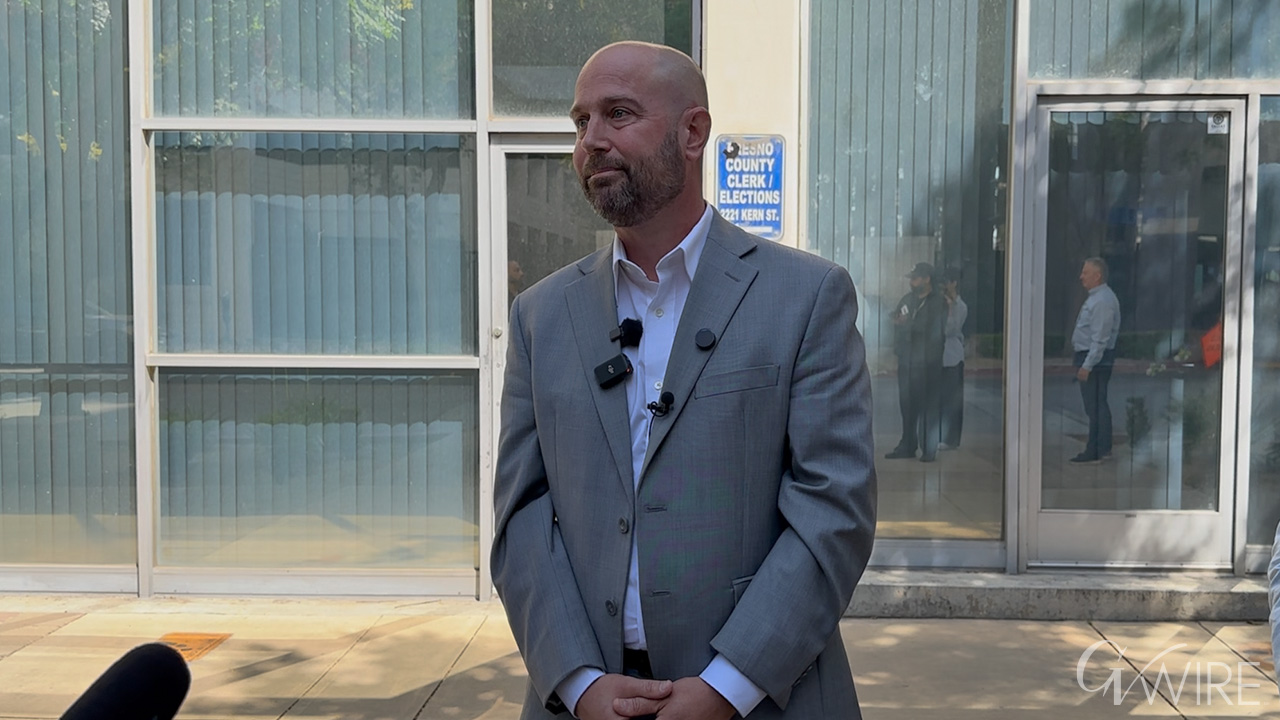
Kus, however, couldn’t promise making the Aug. 7 deadline, much less the July 14 date.
“That is definitely doable, but I cannot promise that we will make that,” Kus said.
That’s important because while approving Kus’ findings is not political, getting a special meeting approved by supervisors would take working with the board.
When asked if he would accommodate a special meeting request, Fresno County Board Chair Garry Bredefeld said he would consider anyone’s request but “wouldn’t commit to anything.”
County Left Out of Measure C Process
The problem goes back to when the third iteration of Measure C was crafted. Supervisors were some of the most critical when the Fresno Council of Governments gave the transportation coalition — made up of environmental advocacy groups and the Central Valley Community Foundation — an outsized role in drafting the ordinance’s language.
The finished product ended up with a heavier allocation toward public transit and innovation (29%) than some politicians — who expected an ordinance intended to repair Fresno County roads — could stomach.
When that process fell apart, the Central Valley Community Foundation quickly funded the ballot initiative process to the tune of $500,000. The Northern California Carpenters Union donated $250,000.
“There was no collaboration,” Bredefeld said. “We tried to negotiate a better deal with our county and our city residents. They were not interested. They had Ashley Swearengin’s money from her backers and they didn’t need to negotiate.”
Additionally, while promoting the Better Roads Safe Streets initiative, organizers never made a stop in the county board room, despite an invitation from the body.
4% Allocation for Regional Projects
The ordinance also only allocated 4% to regional projects, which Fresno County Supervisor Nathan Magsig previously said was not enough to complete a host of projects connecting rural communities, especially those along Highway 180 and in mountain communities.
Magsig told GV Wire he still stands by his statements but added that he was confident Kus and his team would finish the count in time.
The supervisor said he didn’t want to speculate on what would happen if Kus couldn’t.
Transportation experts and politicians also noted how restrictive the measure was in terms of road design. One example: prescribing bike lanes, where leaders said they wouldn’t make sense.
2028 Approval Creates Lag in Tax Money Accumulation
Pushing a Measure C replacement off until 2028 — assuming voters approve it — would create a lapse in road repair coverage. Fresno Mayor Jerry Dyer said existing tax money would probably carry through at least the end of 2027.
“What I anticipate is funding being available for throughout calendar year 2027, but there would be a gap,” Dyer told GV Wire. “There would be a gap sometime in 2028 until the measure could be passed and the funding could start coming in. So you could see a year without the paving like we’re seeing today.”
The fund would also need time to build up before it could be bonded.
Dyer and the Fresno City Council approved a $100 million bond for road repair, but rural communities would be left waiting for tax money handouts.
The city of Firebaugh, under the Better Roads plan, would collect about $45.6 million over 30 years, with about 50% of that coming in the last 10 years, said Robert Phipps, executive director of Fresno COG. Broken down, that’s about $1 million a year for the first 20 years.
Kerman, which is expected to receive about $83.5 million, will likely collect just over $2 million a year for the first 20 years.
“If for whatever reason we were not able to have this on the ballot until 2028, it would really be detrimental, more so for many of our rural communities,” Dyer said.
The post Can Advocates Work With Fresno County to Get Measure C Replacement on the Ballot? appeared first on GV Wire.