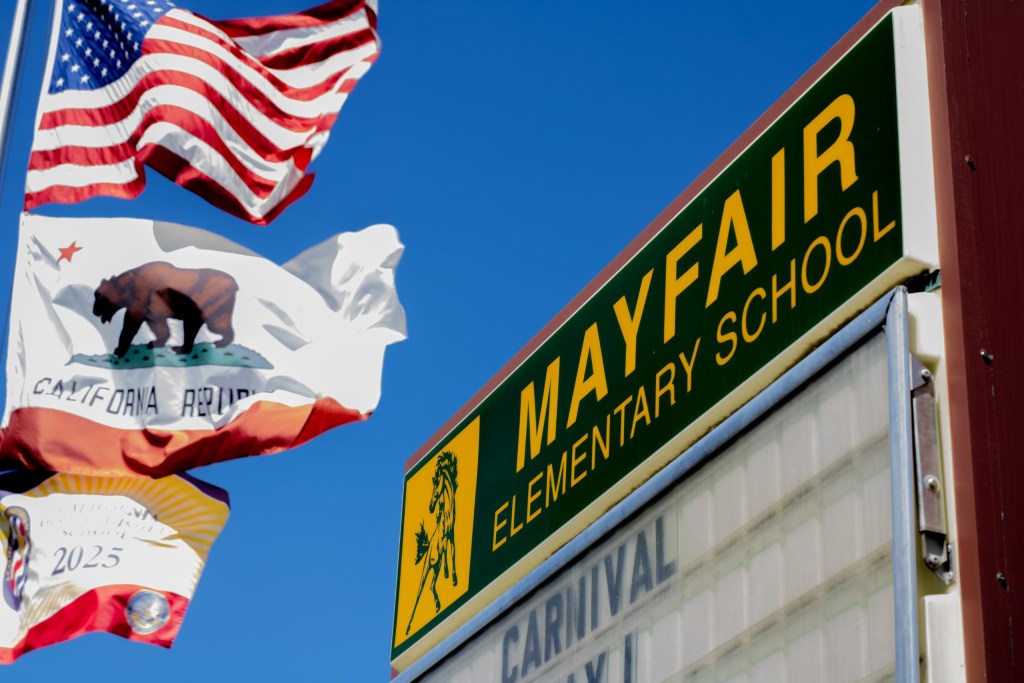

Before they left for Mexico, they told Principal Faviola Perez their kids wouldn’t be at school anymore.
At least 10 families of students at Mayfair Elementary School have approached Perez over the last year to tell her that the federal government’s immigration policies have left them with no choice but to uproot their lives.
“I’m so devastated that I’m losing families,” Perez told Fresnoland. “But I do understand the fear because when I was in fifth grade, I watched my mom get deported. When I was a sophomore at Roosevelt High School, my brother got deported from Roosevelt High School.”
Perez said the effects of national policy trickle down to the local level, and it’s changing local schools. She described enrollment declines due to immigration concerns at Mayfair Elementary as “another COVID.”
But immigration raids are just the latest challenge — and not the main culprit — to keeping students in Fresno Unified schools.
Well before a shift in immigration policy and enforcement tactics last year, student enrollment at Mayfair Elementary plummeted during the pandemic and never recovered. Over the last decade, Mayfair Elementary went from 736 students in 2016 to just 547 enrolled this school year.
That’s a 25% decline, and it’s not even the biggest enrollment drop across California’s third largest K-12 school district.
More than a dozen of Fresno Unified’s schools have lost over 20% of their students over the last decade, and most of the district’s elected trustees have remained silent on the looming school closure debate.
Today, Fresno Unified has 3,901 fewer students than it did a decade ago, according to a Fresnoland analysis of the district’s student enrollment over the last decade.
Those enrollment declines are concentrated at Fresno Unified’s elementary schools and in south Fresno, Fresnoland found.
Olmos Elementary in southeast Fresno has grappled with the second-highest loss in the last decade — nearly 34% of all students. But no school has been more devastated by enrollment declines than Storey Elementary, which has lost almost half its student population in the last decade.

Not all school districts are losing kids
While district leaders acknowledge the simmering school closure debate, they have no appetite to discuss it — and experts suggest there’s even less that the district can do to dig itself out of this growing hole.
Fresno Unified — far from the only California district confronting enrollment declines — currently has no process for identifying which schools may close in the coming years, with internal estimates ranging from three to as many as 11 schools.
“As other districts statewide who have consolidated or closed school sites,” said Fresno Unified spokesperson Adela Duncan, “here at FUSD three to five school sites may be considered, but there isn’t any current projected timeline.”
According to Patrick Jensen, Fresno Unified’s chief financial officer, several factors would need to be considered before closing a school. That includes the age and condition of school sites, the capacity of nearby schools and whether neighboring schools could accommodate incoming students.
On top of that, Jensen said the district would also examine how far schools are from their students, whether a school serves a historically underserved community, traffic patterns and whether students would need to cross busy intersections to go to school.
Fresno Unified’s challenges aren’t unique.
Close to three quarters of all K-12 public school districts in California are grappling with enrollment declines, according to a 2025 analysis from the Public Policy Institute of California.
That analysis also found that enrollment declines are steeper at larger, urban school districts that have more low-income students and a higher share of Latino students.
All of those attributes match up with Fresno Unified: An urban school district — California’s third largest — where 84.16% of students are identified as low-income.
“As far as clawing their way out of declining enrollment, I think a lot of the factors that are driving this declining enrollment overall are quite outside of the school’s control,” said Brett Guinan, a research associate at PPIC.
Declining enrollment isn’t a reality for all school districts, especially those in rural and suburban areas. Additionally, districts with higher shares of Asian and white students — and fewer low income students — are growing, according to the PPIC analysis.
That appears to explain what’s going on at neighboring Clovis Unified.
Student enrollment has been climbing at Clovis Unified since the second year of the pandemic, and the district enrolled a record-high number of students this year.
A Fresnoland review of the Clovis Unified School District confirmed that half of its schools are located within Fresno city limits, but only the northernmost neighborhoods where some of the most affluent communities in Fresno reside and property values are highest.
Guinan confirmed that Clovis Unified’s steady enrollment in the last decade matches similar trends in the state, where districts serving higher concentrations of Asian and white students aren’t facing the same reality as poor urban districts like Fresno Unified.
“Yes, we do see districts with fewer low income students tend to be those that are growing than those that have more low-income students,” Guinan said.

Disparities at elementary schools and in south Fresno
Fresnoland used state data to examine Fresno Unified’s enrollment woes school by school and found that more than 65% of all Fresno Unified schools have fewer students today than they did a decade ago.
Those declines are disparately concentrated at Fresno Unified elementary schools and in south Fresno, according to Fresnoland’s analysis.
The following five Fresno Unified schools had the largest percentage drop in student enrollment over the last decade:
- Storey Elementary
- Olmos Elementary
- Gibson Elementary
- Holland Elementary
- Jefferson Elementary
All five are elementary schools, and three are located south of the 180 freeway.
Over the last decade, the median Fresno Unified school lost 57 students.
Yet, the median elementary school in the district lost 74 students over the same time period.
Additionally, the median Fresno Unified school located south of the 180 freeway has 79 fewer students today than they did a decade ago.
Fresno Unified’s trustees haven’t had a single public conversation at school board meetings about the subject of school closures. Additionally, only one of its seven members spoke to Fresnoland about the likelihood of school closures.
Trustee Elizabeth Jonasson Rosas said she expects school closures to take place at Fresno Unified in the next couple years.
“The ability to have our resources focused in a school that is at capacity or a little below, versus two schools that are half full, is better for our students because we’re not having to maintain two facilities,” Jonasson Rosas told Fresnoland.
She added that closing school has an emotional impact on the communities they serve.
Public school districts get state funding based on the Local Control Funding Formula, which is based on enrollment and how often students show up to school. The decline in enrollment at individual Fresno Unified schools add up, especially for a district with more than 100 schools.
Jensen said those enrollment declines are largely responsible for Fresno Unified’s ongoing budget deficit, which is currently $88 million. District officials project a $55 million deficit for the 2026-27 school year even after approving cuts for 466 employees.
Over the last decade, the district’s largest annual decline in students happened the first year of the pandemic — enrolling 1,151 fewer students in the 2020-21 school year than the prior year.
The second largest annual decline was this year — with Fresno Unified enrolling 995 fewer students in the 2025-26 school year than the year prior.
“That’s basically what we’re struggling with,” Jensen told Fresnoland. “Because if we had stayed flat from where we were at pre-COVID and had the same attendance and same enrollment, we wouldn’t be here.”

Enrollment declines with statewide implications
Across California, K-12 schools have lost around 75,000 students in the past year, with an EdSource analysis showing a drop of nearly 10% in enrollment since the 2017-18 school year.
Guinan, of PPIC, told Fresnoland that those enrollment declines are unlikely to end anytime soon.
“There are definitely trends of declining enrollment statewide that are projected to continue for at least the next five, likely 10 years,” Guinan said, “driven primarily by declining birth rates and by higher migration out of the state than in prior years, especially during the pandemic years, and a slowing of international migration into the state.”
Each of California’s five biggest school districts have issued layoffs notices this year, including Fresno Unified. All but one have been grappling with shrinking student enrollment.
Los Angeles Unified, California’s largest K-12 school district, has already announced plans to close schools. So have a number of other districts, including San Jose Unified and Vallejo City Unified. At Oakland Unified, over 60 principals have called for the district board to close schools to balance a $100 million current deficit.
Additionally, the adoption of transitional kindergarten, or TK for short, did not have the enrollment impacts educators and leaders across the state were hoping for. It also hasn’t really changed enrollment figures for school districts across the board.
“With the expansion of transitional kindergarten statewide, that’s offset some of the declining enrollment, because it’s essentially added a new grade in for even younger students,” Guinan said. “But take up for TK hasn’t been quite as high as the program has expanded, not everyone who is eligible uses it.”
Historically, Guinan says that enrollment declines are larger in high school years than earlier grades. However, she confirmed that recent data trends are showing larger drops in enrollment in early grades, a trend that appears to be taking place at Fresno Unified.
“Recently, we are seeing bigger drops in enrollment among those earlier grades, and again, that’s likely due to this kind of lower birth rate,” Guinan said. “There just are fewer kids that can be entering the system.”

The very real impact of shrinking enrollment
Over at Mayfair Elementary, losing a quarter of its students in the last decade has had a marked impact on the school.
Lyle Patty, who has been teaching at Mayfair since 2014, recalled each grade level having at least five classes of students at the K-6 school. After steep declines during the pandemic, most grade levels at Mayfair now only have enough students for up to three classes.
“I find that the attendance decreases, but the responsibilities still stay the same,” Patty said. “Whether I have more resources or not, I still have the same expectations.”
Perez, Mayfair’s principal, said the school will be losing a third grade teacher along with a social worker and a restorative practice counselor, all part of the district’s cuts. She said she expects to truly feel the impacts of declining enrollment and average daily attendance (ADA) next year — which both directly impact state funding levels for Fresno Unified.
“The most important resource, most important capital that you have on your campus, is your adults,” Perez said, “and if we can’t pay the adults because we don’t have the ADA coming, then we’re losing the resources that are going to be able to help the students of Fresno Unified.”
Perez, who was born in Culiacán, Mexico, was able to pursue a higher education after AB 540 passed in 2001, allowing her to be eligible to pay in-state tuition at Fresno State. Just last year, she earned her doctoral degree in educational leadership as a Bulldog.
For Perez, who was undocumented up until she was 21 years old, she sees herself in the children and families who are choosing to move away amid heightened immigration enforcement.
The post Here are the Fresno Unified schools that have lost the most students over the past decade — and what it means appeared first on Fresnoland.