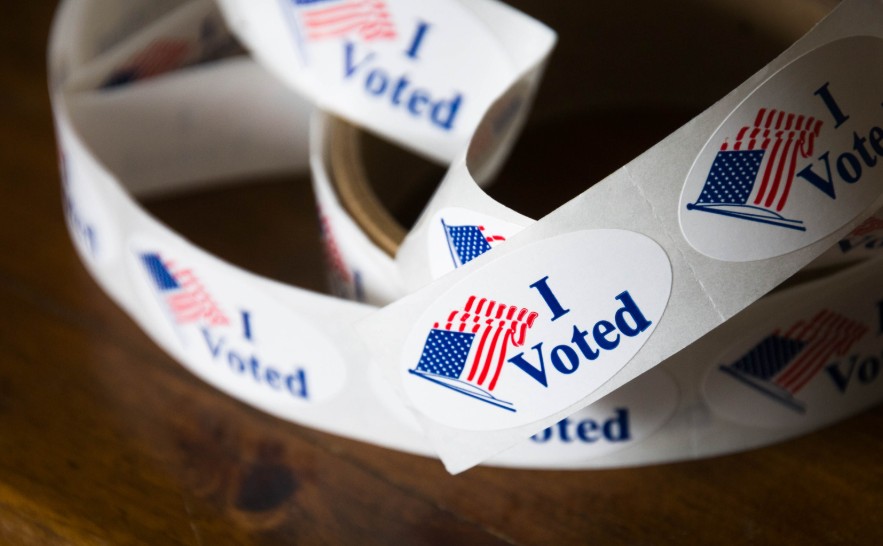
California voters will decide in a special election Nov. 4 whether to temporarily replace the state’s nonpartisan congressional district maps with new, legislatively drawn boundaries.
Proposition 50 comes in response to other states redrawing their district maps ahead of schedule.
The U.S. House of Representatives has 435 members who make up half of Congress, the federal lawmaking body. Each member represents a specific area within a state called a congressional district. The number of districts, and therefore the number of representatives, each state gets depends on its population, as measured by the U.S. Census every 10 years. California has 52 congressional districts.
Voters in each district elect one representative to serve a two-year term in the House, and all 435 seats are up for election every two years. The next House election will take place in 2026.
After each census, states must redraw their congressional district boundaries to reflect population changes. This process, called redistricting, determines how communities are grouped for representation in the House. Each state decides who controls redistricting —usually the state legislature, although some states, including California, have independent commissions to draw the maps.
Under normal circumstances, new district maps are drawn only once every decade following the census. However, some states have recently redrawn their maps ahead of schedule, while others are considering doing so. For example, Texas approved new maps for the 2026 elections, prompting several other states to contemplate similar changes.
Prop. 50 would place California among those states abandoning the usual redistricting schedule by temporarily setting aside the state’s independent redistricting commission and allowing the Legislature’s newly drawn congressional maps to take effect for the 2026 through 2030 elections. After the 2030 census, the independent Citizens Redistricting Commission would resume responsibility for drawing the state’s congressional maps.
What a “yes” vote means
A “yes” vote would allow the state to adopt and use the Legislature’s new congressional maps beginning in 2026. Those maps would remain in place until new maps are drawn after the 2030 Census.
What a “no” vote means
A “no” vote would keep California’s current maps, drawn by the Citizens Redistricting Commission in 2021, through the 2030 election cycle.
Supporters’ view
Supporters, including Gov. Gavin Newsom, say Prop. 50 is an emergency measure to counter partisan redistricting in states such as Texas that could influence control of the U.S. House of Representatives. They say it would help maintain political balance in Congress amid partisan mapmaking nationwide.
Opponents’ view
Opponents contend the measure undermines voter-approved reforms that removed politicians from the mapmaking process. They say Prop. 50 would weaken safeguards designed to keep local communities together and prevent maps that favor one political party over another.
Fiscal impact
If Prop. 50 passes, the Legislative Analyst’s Office estimates one-time costs of up to a few million dollars for counties statewide and about $200,000 for the state to update election materials to reflect new congressional maps.
The Chamber’s position
The Fresno Chamber of Commerce opposes Proposition 50 because it undermines the fair, transparent process established by the California Citizens Redistricting Commission and represents poor governance. The measure threatens to weaken our democracy and inject uncertainty into the legislative process. Dividing Fresno County into different districts would dilute our community’s voice and obstruct accurate representation of Central Valley priorities.
From a business perspective, stability in government is essential for fostering economic growth and investor confidence. Prop. 50 imposes an unfair and unnecessary redistricting scheme at the expense of taxpayers and the business community. For the sake of good governance and a healthy economy, we urge a “no” vote on Proposition 50.
For more updates on Fresno County development and business initiatives, stay connected with the Fresno Chamber of Commerce.