
FRESNO, Calif. – The debate over the proposed Range of Light National Monument[1] (House of Representatives Bill 9600[2]), which would encompass 1.4 million acres of Sierra National Forest, has sparked mixed reactions across the Central Valley. The monument’s designation is seen as a potential advantage for eco-tourism, promising economic growth through increased visitor numbers, federal funding, and infrastructure improvements. However, the proposal has also raised concerns about its potential to worsen the growing severity, and frequency of wildfires near the Central Valley, along with its broader implications for forest management.
Forest Management Challenges and Wildfire Affect on Air Quality
The proposed Range of Light National Monument has sparked heated debate in our community. On one hand, its goal to protect 1.4 million acres of the Sierra National Forest could significantly boost eco-tourism. On the other hand, it raises serious concerns about forest management. For example, preservation efforts could worsen vegetative overgrowth, which would heighten wildfire risks.
Wildfires have been growing more severe and frequent over the past several decades. In fact, “wildfire emissions in 2020 essentially negate 18 years of reductions in greenhouse gas emissions,” according to Jerrett, Jina, and Marlier (2022). Furthermore, researchers from UCLA and the University of Chicago found that carbon dioxide emissions from California’s 2020 wildfires were nearly double the state’s total greenhouse gas reductions since 2003.
This raises a pressing question: can the Department of the Interior effectively manage such a vast area to mitigate these environmental threats? Many worry the answer may be no.
Local Perspectives on Range of Light Monument and Forest Management
Kelly Kucharski from the Sierra Resource Conservation District emphasized the need for responsible forest management. She stated, “It’s crucial to remove dead or diseased trees and understand that fire is a natural part of the ecosystem.” Local tribes, she explained, have long practiced prescribed burns to maintain forest health. Additionally, the Sierra Resource Conservation District has been working closely with the community. Through education, they have created ten Firewise communities since the 2020 Creek Fire.
Meanwhile, tribal members have voiced strong concerns about the Range of Light Monument. They argue that it could restrict access to lands essential for cultural practices. Furthermore, it might undermine the USDA Forest Service’s longstanding efforts to build and maintain positive relationships with tribes. A member of the Dunlap Band of Mono Indians criticized the bill, stating, “This bill, imposed by Bay Area legislators, fails to consider the impacts on our communities, workforce, and way of life.” They added that it overlooks social and economic concerns. Additionally, it disregards the USDA Sierra and Sequoia Plan Revision, which involved local tribes. Without proper consultation, they warned, “this plan is doomed to fail.”
Forest Health and the Role of Biomass
A key concern among conservation groups is that the Range of Light Monument might prioritize preserving biomass instead of addressing vegetative overgrowth. This approach could enhance biodiversity. However, it may also increase the fuel available for wildfires. For instance, discouraging the removal of diseased trees or limiting controlled burns could worsen wildfire intensity.
Healthy forests typically act as carbon sinks, absorbing carbon dioxide from the atmosphere. Yet, wildfires in unmanaged areas burn much hotter than in treated zones. As a result, forests can shift from being carbon sinks to becoming carbon sources, releasing stored carbon back into the air.
The Ecological Importance of Fire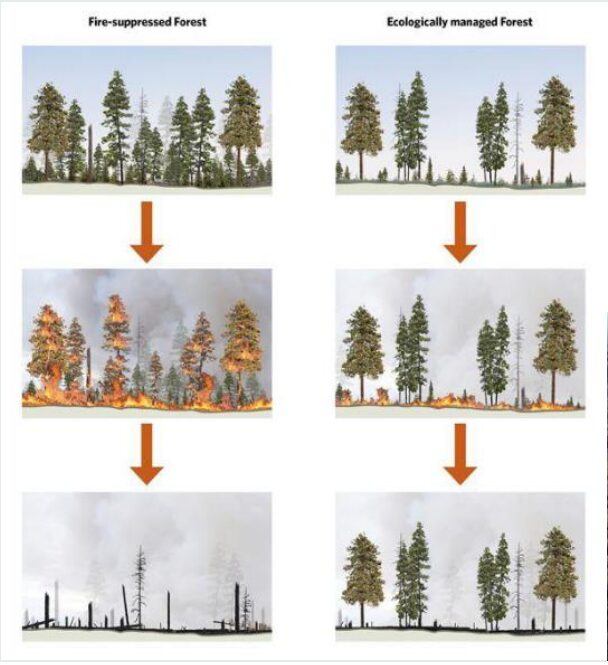
Fire is a natural and necessary part of the Sierra Nevada ecosystem, as it plays a crucial role in clearing undergrowth and promoting biodiversity. However, over the years, decades of fire suppression have significantly disrupted this delicate balance, ultimately leading to dangerous vegetative overgrowth that fuels catastrophic wildfires. Consequently, preservation efforts without proactive management not only risk compounding this issue but also make forests less resilient and increasingly vulnerable to devastating fires.
This image from The Nature Conservancy illustrates how vegetative overgrowth adds fuel for wildfires. As a result, fires become hotter and spread more widely. In contrast, the right side of the image shows an ‘ecologically managed forest.’ Here, controlled burns and proper tree spacing work together to slow the spread of fires. Ultimately, these practices help protect the forest.
The Future of the Range of Light Proposal
The fate of the Range of Light bill remains uncertain. While the Biden Administration may sign it into law before vacating office, there is a possibility that a future administration—particularly a return of the Trump Administration—could reverse or significantly alter the monument’s designation. A shift in leadership could redirect federal priorities away from preservation, focusing instead on industrial development and less restrictive land management practices. Such a reversal could leave the region in limbo, uncertain of its future and how best to address the ongoing wildfire crisis.
The Range of Light National Monument proposal has ignited a passionate discussion about the balance between preservation and proactive forest management, or conservation. While its supporters envision a future of enhanced eco-tourism and environmental protection, its critics warn of unintended consequences, including increased wildfire risks and limited access for tribal and local communities.
References
County of Fresno Board of Supervisors Letter to the Biden Administration
[1] Unite the Parks. (n.d.). The Range of Light National Monument. Retrieved from https://www.unitetheparks.org/the-range-of-light-national-monument
[2] U.S. Congress. (2022). H.R.9600 – Range of Light National Monument Act. 117th Congress. https://www.congress.gov/bill/117th-congress/house-bill/9600
[3] Valley Clean Energy. (2020). Valley Clean Energy: 2020 Integrated Resource Plan. Valley Clean Energy. pp. 141-151. https://www.valleycerf.org/_files/ugd/69d6c8_872dcac4f0f9403d9e057df0667b2380.pdf
[4] Valley Clean Energy. (2020). Valley Clean Energy: 2020 Integrated Resource Plan. Valley Clean Energy. pp. 141-151. https://www.valleycerf.org/_files/ugd/69d6c8_872dcac4f0f9403d9e057df0667b2380.pdf