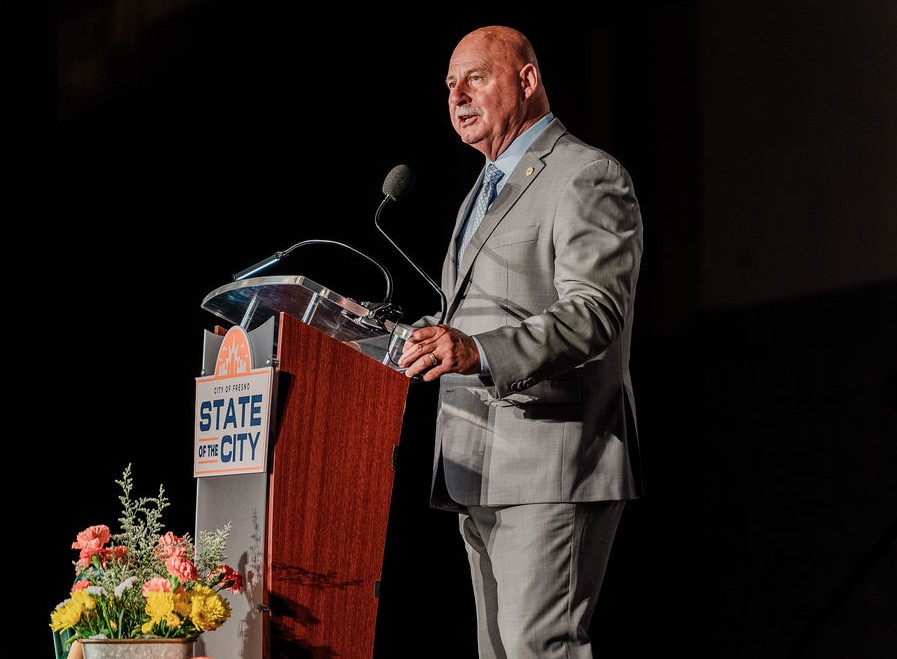
Fresno Mayor Jerry Dyer shared a vision of a city strengthened by diverse projects as he highlighted budget priorities during his 2025 State of the City address Thursday, May 8.
During the sold-out event in partnership with the Fresno Chamber of Commerce, he highlighted nearly $900 million dollars budgeted for over 440 projects in four areas: parks, public safety, infrastructure, and housing.
In the area of parks, Fresno will gain green space as construction advances on a 49-acre park on Peach Avenue and the 10-acre Les Kimber Park in southwest Fresno.
Additionally, designs are in the works for Dolores Huerta Park on Dakota and Milburn avenues and an enhanced BMX track at Woodward Park.
Fresno residents will also enjoy new amenities including play structures, cricket pitches, and pickleball courts.
To advance public safety, construction will begin on a new 911 communications center at the city’s municipal yard this year. Construction will start on Fire Station #12 on Ashlan and Valentine avenues to replace the station at 2874 W. Acacia. A $25 million grant from the state allows the city to partner with State Center Community College District to construct a regional training center for firefighters.
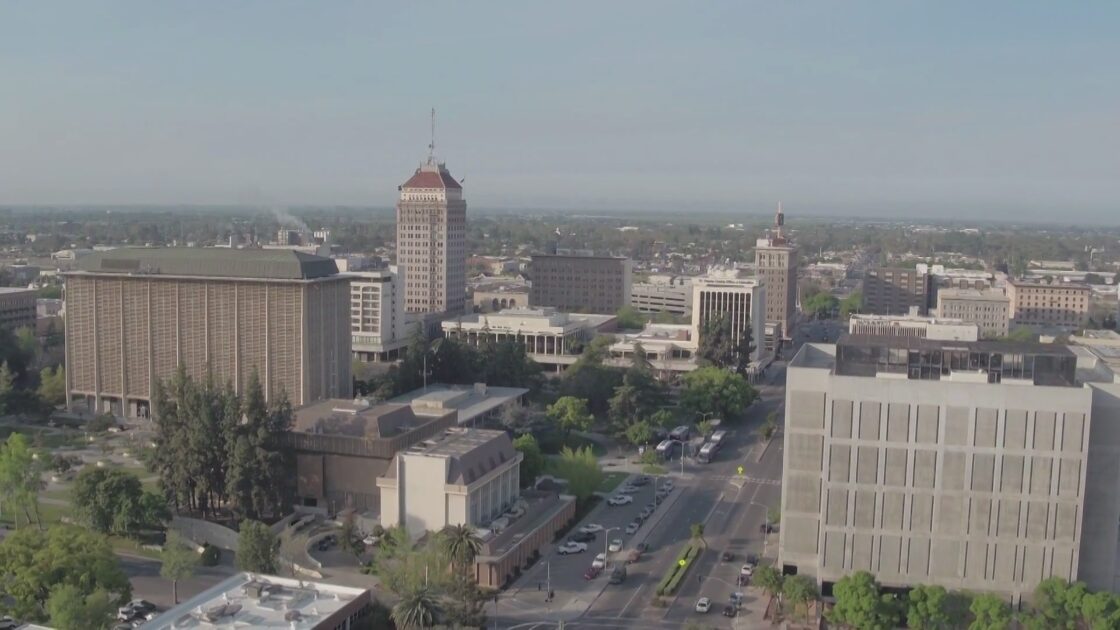
Turning to infrastructure and housing, downtown and Chinatown will benefit from funds for infrastructure and catalytic housing development.
The city has received the first installment of $50 million as part of a $250 million commitment from the state, as well as a separate $43.7 million grant. The first phase of water and sewer improvements will be completed this fall, with additional phases to begin shortly thereafter.
“These upgrades are foundational to supporting future growth and development,” Dyer said.
Two parking garages are planned for downtown: one across from Chukchansi Park and another near the former CVS on Fulton, which is slated to be demolished this year.
Chinatown will benefit from sidewalk improvements and urban greening. Demolition of the Bow On Tong building will create space for 35 housing units.
The Tulare Street underpass reconnecting downtown and Chinatown is expected to open by the end of June.
“Securing the delayed $200 million – I’m going say this loud enough for the governor to hear – the delayed $200 million in state funds is absolutely essential to completing the remaining work in downtown and Chinatown,” Dyer said.
Other construction projects include the first citywide senior activity center, outfitting every bus shelter with a shade structure, and a grade separation project at Blackstone and McKinley avenues to eliminate the need for cars to stop for trains.
Fresno Yosemite International Airport is undergoing its biggest terminal expansion ever, starting with the opening of a new passenger screening checkpoint last month. The last phase is expected to be wrapped up this fall with the addition of two gates and an enhanced inspection and security screening area. These additions will triple the airport’s international flight capacity.
Regarding housing, Dyer emphasized the city’s focus on affordability. This year, 860 affordable housing units are planned, with 1,500 projected for 2026.
“The more affordable housing we have, the less people we have on our streets experiencing homelessness,” Dyer said.
He also emphasized that it is time for the city to grow. “While there continues to be demand in development within our city limits, Fresno also faces a pivotal moment when it comes to growth, which is why we must begin developing in the Southeast Development Area, also known as SEDA.”
SEDA includes plans for 40,000 housing units, schools, parks, and businesses.
However, rather than moving forward with all four phases of SEDA in the near future, Dyer proposes beginning infrastructure in the southern portion, known as South SEDA. “The area between Jensen and North avenues and Minnewawa to Temperance avenues will deliver the most expedient return on investment such as infrastructure costs while providing a good balance of housing and industry. God knows we need more industry for jobs in our city.”
Planning these upgrades to the city while balancing the budget was challenging, Dyer said. The city faced a $20.6 million deficit in March that grew during the budget process due to factors including a shortfall in revenue streams, rising expenses driven by inflation, employee contracts, service agreements, and utility costs. Additionally, the city no longer has access to one-time funds including the Coronavirus Aid, Relief and Economic Security Act; the Emergency Rental Assistance Program; and the American Rescue Plan Act.
However, Dyer said every department found savings and made cuts to eliminate the deficit, which will allow him to present a balanced budget to the council Thursday, May 15.
He emphasized seizing the moment to build a stronger city: “This is our time, Fresno – a time to grow and a time to build, to build upon a safer, cleaner, Fresno.”
For more updates on Fresno County development and business initiatives, stay connected with the Fresno Chamber of Commerce.