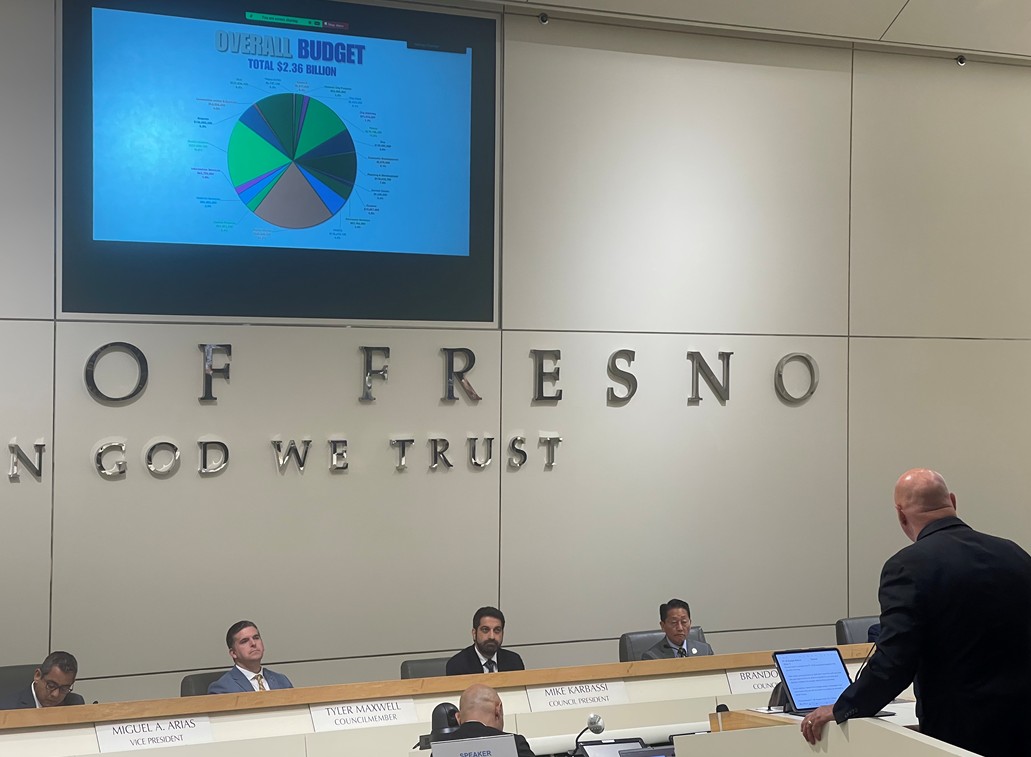
Fresno Mayor Jerry Dyer credited city departments for helping close a $50 million budget gap as he presented the $2.36 billion spending plan to the City Council on Thursday, May 15.
“In my opinion, this budget sends a very, very strong message to our community that we will live within our means in city government but we will also at the same time build a better future for Fresno,” Dyer said.
The budget shortfall was driven by rising costs tied to inflation, contractual obligations, and personnel expenses. Meanwhile, one-time funds — including money from the American Rescue Plan Act and the Coronavirus Aid, Relief, and Economic Security (CARES) Act — have expired.
However, property tax ($202.6 million) and sales tax ($143.8 million) contributed a solid hunk of budget funds. Additional revenue sources included business licenses ($23.6 million), room tax ($16.5 million), and other revenues ($122.6 million). The “other revenues” pot is filled by diverse sources including carryover funds from fiscal year 2025, Prop. 172 money, development fees, card-room revenue, real estate transfer tax, and fines. Cannabis tax ($3.4 million) fell short of expectations, but hopes are high as the number of dispensaries is expected to grow from 13 to 18 in fiscal year 2026.
Early in fiscal year 2025, city officials noticed that expenses were outpacing revenue and began looking for savings. One focus was selective hiring and holding job vacancies, which contributed to the carryover used in the FY 2026 budget.
Despite those efforts, by the middle of FY 2025, the city projected a $20.6 million shortfall for the next year. As departments factored in essential services and contractual obligations, the gap widened to over $50 million.
To help close it, the city returned to its strategy of saving through attrition. All departments except the City Council and fire department are asked to maintain a 6.18% vacancy rate, saving about $25.4 million.
Every department was asked to trim 5% in non-personnel spending. While some couldn’t hit the full target without service impacts, others cut more. Together, these reductions saved $11.5 million.
Despite the cuts, the budget includes hundreds of projects to strengthen and beautify the city. Nearly $900 million is allocated for over 440 public works, parks, and capital improvement projects.
“The FY 26 budget represents an unprecedented season of growth and development in Fresno thanks to special revenue sources,” Dyer said. “And these investments span areas such as parks, public safety, infrastructure, and housing.”
For more updates on Fresno County development and business initiatives, stay connected with the Fresno Chamber of Commerce.